

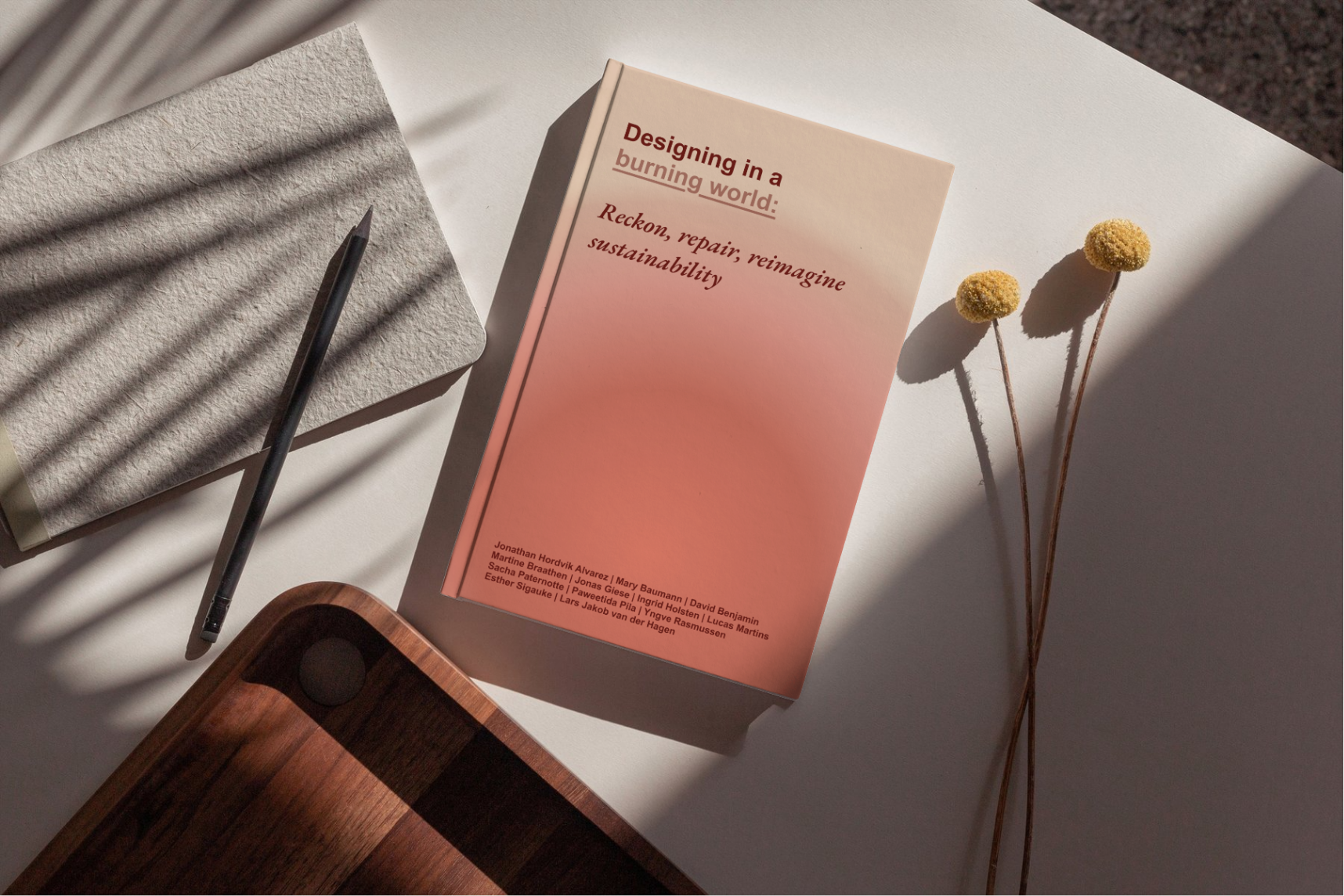
Designing in a burning world
Reckon, repair, reimagine sustainability.
Graphic design and writing
2025
About
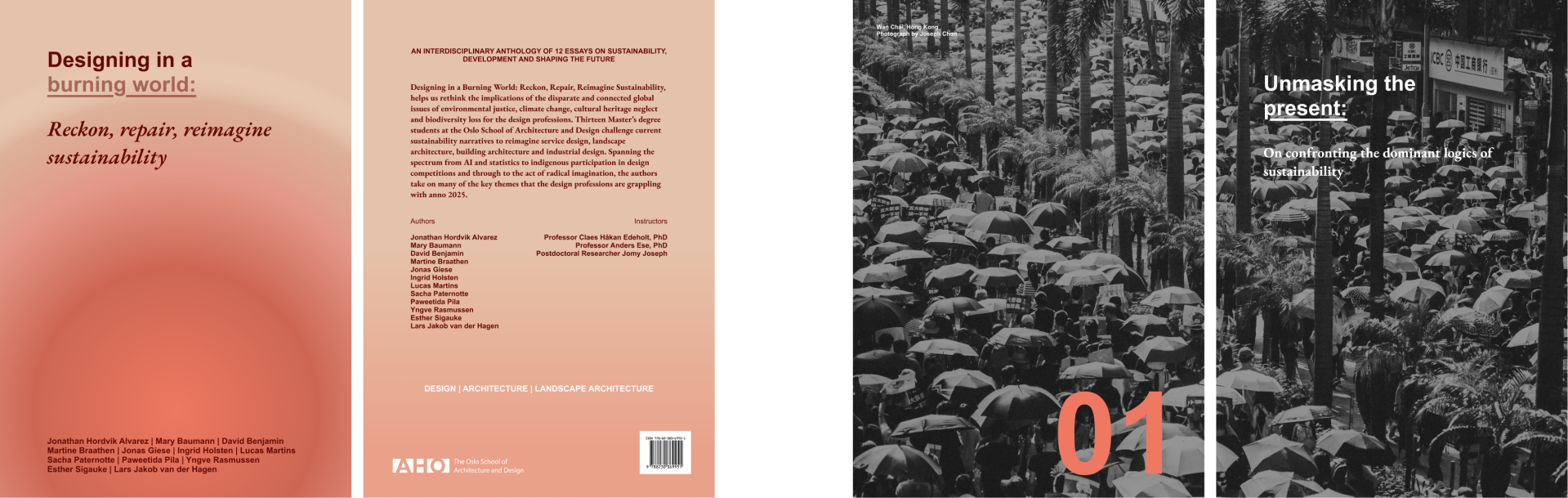
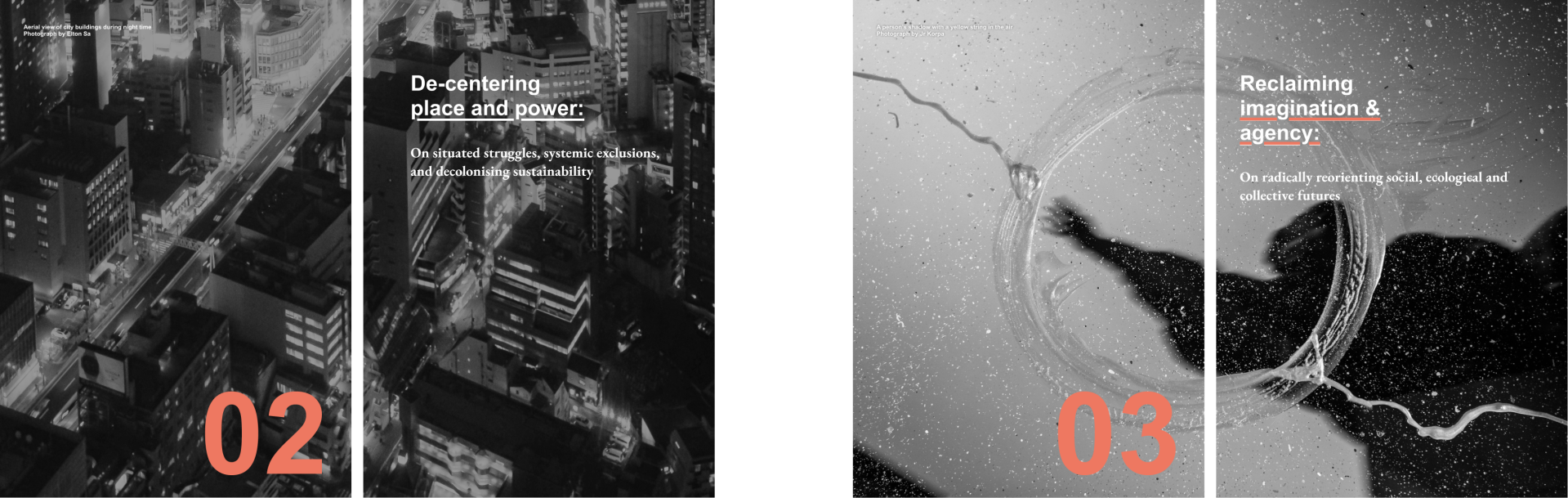
Designing in a Burning World: Reckon, Repair, Reimagine Sustainability, helps us rethink the implications of the disparate and connected global issues of environmental justice, climate change, cultural heritage neglect and biodiversity loss for the design professions. Thirteen Master’s degree students at the Oslo School of Architecture and Design challenge current sustainability narratives to reimagine service design, landscape architecture, building architecture and industrial design. Spanning the spectrum from AI and statistics to indigenous participation in design competitions and through to the act of radical imagination, the authors take on many of the key themes that the design professions are grappling with anno 2025. An interdisciplinary anthology of 12 essays on sustainability, development and shaping the future where I wrote an essay and I was responsible for designing the book's identity and graphic design.
The Role of Service Design in a Just and Sustainable Transition
My essay is called The Role of Service Design in a Just and Sustainable Transition. The essay explores how service design can support fair, inclusive, and long-term sustainability. Martine Braathen reflects on her experience as a service design student, observing that traditional projects often prioritize immediate user needs over systemic and environmental impact. She argues that service design must evolve to address both people and the planet, embedding sustainability and justice at the core.
By integrating Just Transition principles, service design can help ensure that societal shifts toward sustainability are equitable, protecting vulnerable groups, supporting green jobs, and involving communities in decision-making. The Helsinki Mobility as a Service (MaaS) project illustrates this: by co-creating accessible, sustainable transport solutions with users and stakeholders, service design enabled systemic change that benefits both communities and the environment.
I emphasise that service design’s human-centered, inclusive, and iterative methods make it uniquely suited to advance Just Transition. However, designers must rethink their tools and practices, not just optimise existing services; by including power mapping, storytelling, and co-creation with affected communities.
Ultimately, service design is not neutral: it can either reinforce inequity or facilitate meaningful, sustainable change. By focusing on people, systems, and participation, designers can help reimagine services and infrastructures that are ethical, resilient, and aligned with environmental and social justice goals.

Address
Bjerregaards gate 21
Oslo, Norway
Socials